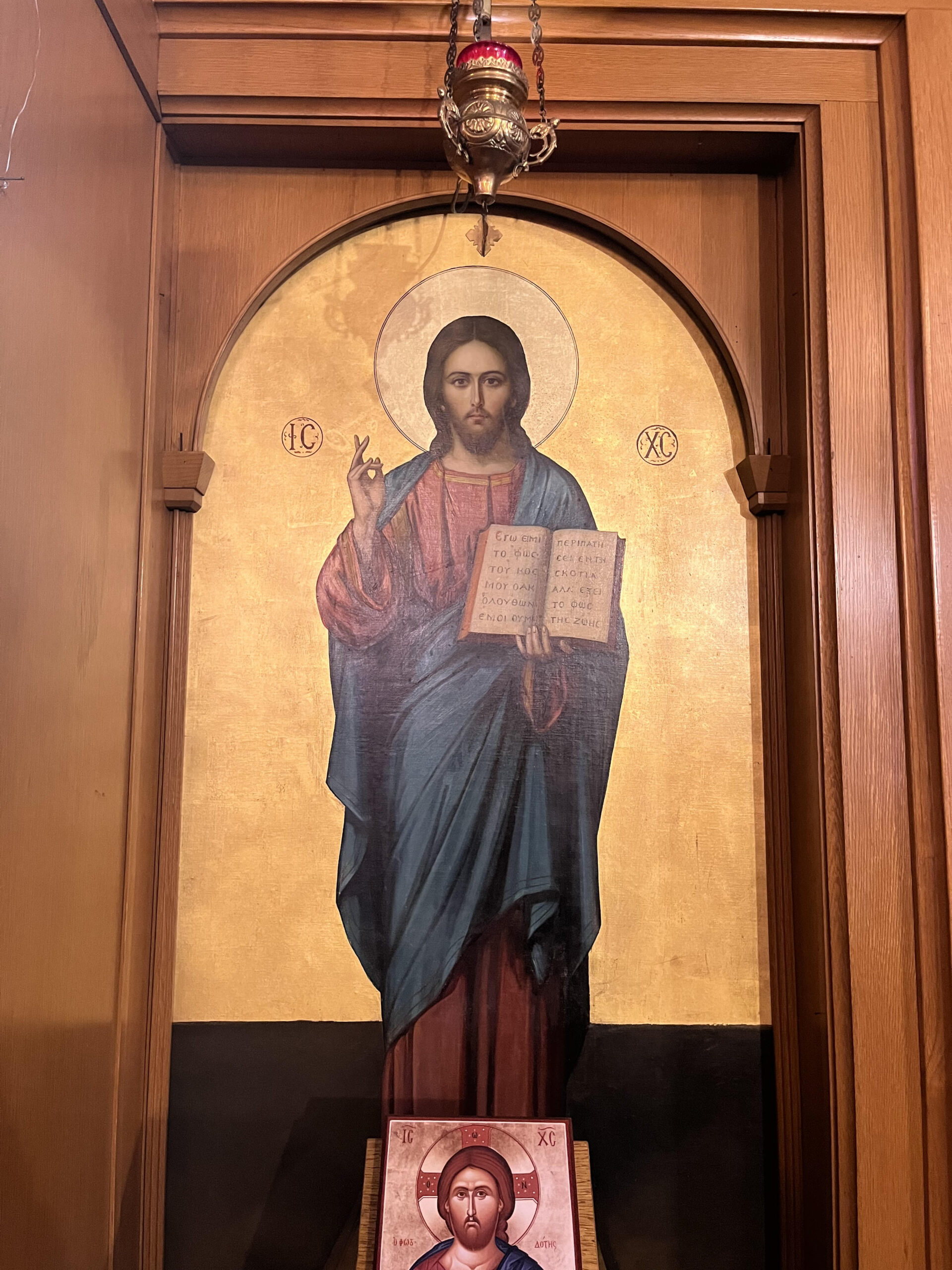
Pray then like this: Our Father Who art in heaven.
Matthew 6:9
Today we resume the series “The Greatest Sermon: Reflections on the Sermon on the Mount” which we paused for Great Lent and Holy Week.
Jesus began a teaching about prayer by warning His followers that prayer is not about being seen by others, but rather coming into union with God in a private, personal way. He also warns against heaping up empty phrases, that prayer is not about many words. And then He introduces His followers to what is now known as “The Lord’s Prayer.” It is the only complete prayer uttered by Jesus, which can be used in all circumstances. Jesus offers other words of prayer, such as a prayer before the tomb of Lazarus (John 11), or a prayer in the Garden of Gethsemane (Matthew 26, Mark 14); however, these prayers are circumstantial, based on what was happening at the moment in His ministry. The Lord’s Prayer is a prayer that can be offered by anyone, at any time, in any circumstance.
Elements of prayer include glorification of God, intercession for others to God, confession of sins, supplication (asking God for something) and thanksgiving. All of these are present in the Lord’s Prayer when we offer our prayers with a thankful heart.
We pray the Lord’s Prayer often, both in our services and outside of them, and perhaps because of this, we do it without paying attention to what we are saying, and we therefore, lose the rich meaning of its words. Many people, when asked to lead a group in prayer, will go to the Lord’s Prayer, as many people are uncomfortable praying with their own words and just default to the Lord’s Prayer. If people know one prayer, it is this one. The Lord’s Prayer IS the consummate prayer, because if we really understand its words and apply them, it covers all elements of prayer and faith.
The Lord’s Prayer begins with two words that summarize the two great commandments: Our Father.
In Matthew 22:34-40, we read:
But when the Pharisees heard that He had silenced the Sadducees, they came together. And one of them, a lawyer, asked Him a question, to test Him. “Teacher, which is the great commandment in the Law?” And He said to him, “You shall love the Lord your God with all your heart, and with all your soul, and with all your mind. This is the great and first commandment. And a second is like it, You shall love your neighbor as yourself. On these two commandments depend all the Law and the prophets.”
The prayer does not address God in an individual way, “my Father” but a collective “our.” Salvation is not a solitary pursuit. We pray on behalf of others and others pray for us. Part of an individual journey to salvation must include concern for the salvation of others. God is the Father of the entirety of our Church.
“Father” is a term of a loving and intimate relationship. As Christians, we don’t pray “dear distant deity” but instead cry out to “our Father.” There is one challenge to the use of the word “father” can be either comforting or problematic, based on one’s relationship with his or her earthly father. It is also sometimes hard to look at God as a benevolent Father when things are going wrong for us. God knows what is best for us, even if we don’t know it ourselves. We may not understand everything about our Father, and why He guides us in a certain way. This is where faith, trust and obedience come in.
The statement, “who art in heaven,” is not about geography or distance, but character. It establishes God’s divinity, timelessness and power. St. Paul writes in Ephesians 4:4-6, There is one body and one Spirit, just as you were called to the one hope that belongs to your call, one Lord, one faith, one baptism, one God and Father of us all, who is about all and through all and in all.
There are two things about Jewish thought that radically changed in the giving of the Lord’s Prayer. The first thought that changed was that God was unapproachable and to be feared. In the Lord’s Prayer, Jesus reveals God as “our Father” which paints a picture of a benevolent father with whom we can have an intimate relationship, rather than a vengeful God that is distant. The second prevailing thought that changed is that God is everywhere, which is a departure from the Old Testament through that His presence was limited to the temple. Jesus would explain this further in John 4:20-24, in a dialogue with a Samaritan woman, which beings with her saying:
“Our fathers worshiped on this mountain; and You say that in Jerusalem is the place where men ought to worship.” Jesus said to her, “Woman, believe Me, the hour is coming when neither on this mountain nor in Jerusalem will you worship the Father. You worship what you do not know; we worship what we know, for salvation is from the Jews. But the hour is coming, and now is, when the true worshipers will worship the Father in spirit and truth, for such the Father seeks to worship Him. God is spirit, and those who worship Him must worship in spirit and truth.”
The entire Sermon on the Mount is an exclamation of change and inauguration of a new way of thinking about God, faith, prayer and so many other things. And one of the biggest changes was the introduction of the Lord’s Prayer, specifically it’s beginning, that God is a benevolent father and that our journey towards salvation is a collective effort, rather than just a personal one.
Let God arise, and let His enemies be scattered; let those who hate Hi flee before Him! As smoke is driven away, so drive them away; as wax melts in the presence of the fire, let the wicked perish before God! But let the righteous be joyful; let them exult before God; let them be jubilant with joy! Sing to God, sing praises to His name; lift up a song to Him who rides upon the clouds; His name is the Lord, exult before Him! Father of the fatherless and protector of widows is God in His holy habitation. God gives the desolate a home to dwell in; He leads out the prisoners to prosperity; But the rebellious dwell in a parched land. . .Ascribe power to God, whose majesty is over Israel, and His power is in the skies. Terrible God in His sanctuary, the God of Israel, He gives power and strength to His people. Blessed be God! Psalm 68:1-6, 34-35
Points to ponder: Do you think there is any significance that Jesus instructs us to pray OUR Father rather than MY Father? Do you pray more for yourself or for others? How important to you is it to pray with others as opposed to only praying alone?