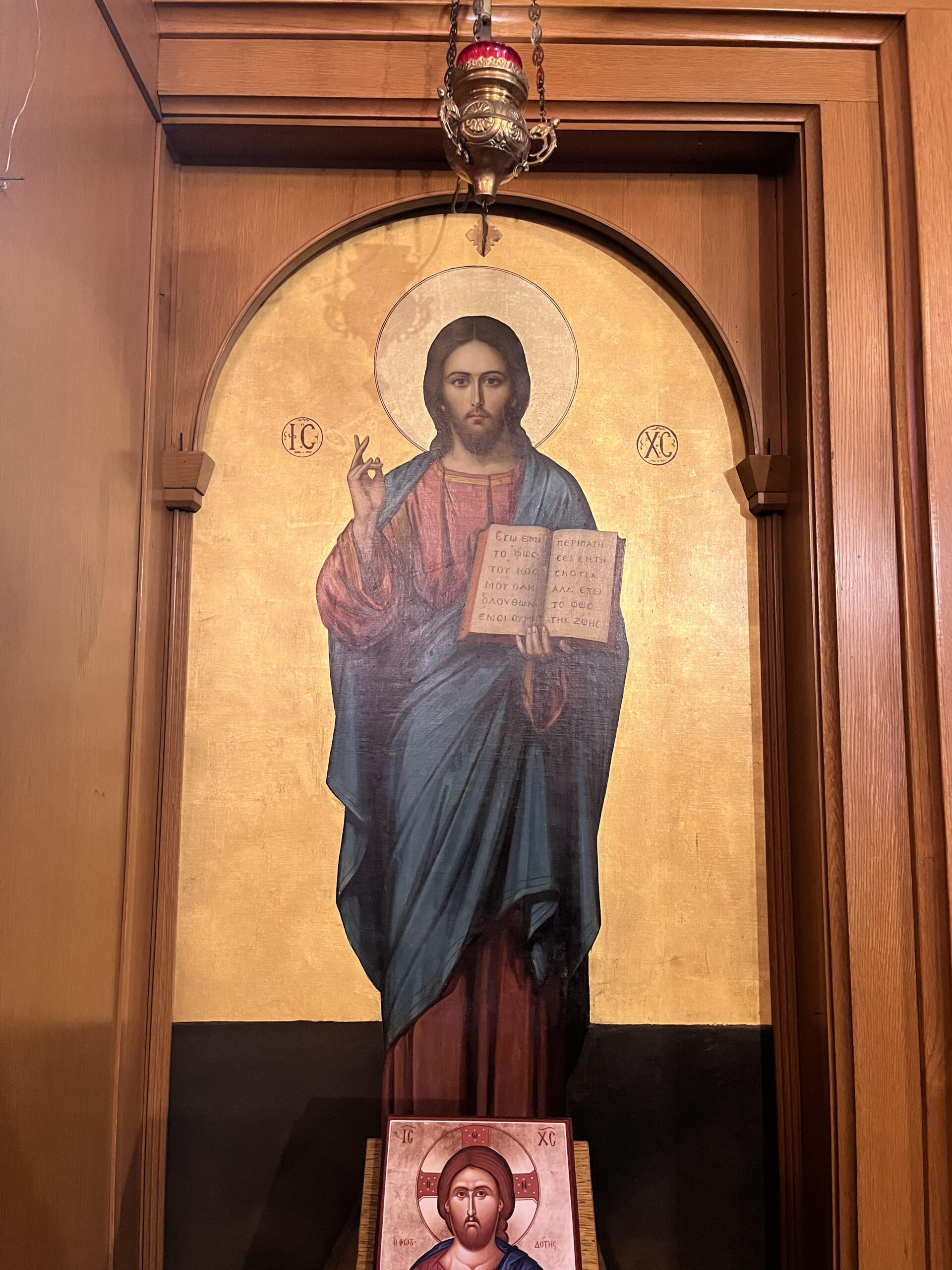
For the kingdom of God does not consist in talk but in power.
I Corinthians 4:20
The Divine Liturgy begins with the words “Blessed is the Kingdom of the Father and of the Son and of the Holy Spirit, now and forever and to the ages of ages. Amen.” The most important word of the Divine Liturgy is found in this first sentence and it is the word now. When we think of the Kingdom of Heaven, we think of salvation and eternal life, something that will last forever, a place where we will be forever. However, the Divine Liturgy brings us into the Kingdom of Heaven here and now. We stand in the presence of Christ, we receive Christ, and we stand in the presence of the angels and the saints. The Church, inspired by the Holy Spirit, has given us a place to get a glimpse into heaven, a place to experience heaven, and a place to practice what it will be like to live in heaven. The Divine Liturgy prepares us to pass from this life and enter eternal life. Those who have prepared should not leave earthly life in fear but rather will be prepared to experience a more perfect and complete experience of something they have prepared for in this life.
We don’t have to wait for the Divine Liturgy to experience a foretaste of heaven, even though this remains the best way to prepare and the best glimpse of what is ahead of us for eternity. Loving God and loving others is already stepping into the Kingdom. We previously discussed the prayer of Christ in John 17: 21-23, for His hope “That they (us) may all be one; even as Thou, Father, art in Me, and I in Thee, that they also may be in Us, so that the world may believe that Thou hast sent Me. The glory which Thou hast given Me I have given to them, that they may be one even as we are one, I in them and Thou in Me, that they may become perfectly one.”
When we express our love for God, in prayer and in worship, it is possible that we become one with God in that moment. The moments are fleeting. We cannot remain in prayer and worship perpetually, because earthly thoughts like hunger and fatigue will eventually distract us. And sinful thoughts and temptations will creep in, and we will have to fight them off. However, we can experience moments of oneness with God, especially in receiving the Eucharist, when we experience, we become physically one with Christ, where He touches us and where we touch Him in the most spiritually intimate of embraces. This is why Holy Communion should never be viewed as a “have to” receive but a “want to” receive as often as possible, to feel that closeness with Christ.
On a smaller but still very powerful scale, we enter into the Kingdom of Heaven when we love our neighbor. When we take something from ourselves and project it onto someone else, whether that is patience, kindness, optimism, forgiveness, sacrifice or any of the other gestures that manifest love, we are experiencing a foretaste of heaven. If God is perfect love, without anything else, then heaven will be an experience of love without anything else—no struggle, sorrow, temptation, envy, anger, etc. So, when we serve our neighbor, when we put aside struggle, sorrow, temptation, envy, anger and we just serve, we are also experiencing a foretaste of the Kingdom of Heaven. In sports, they say we play how we practice. If we haven’t practiced love in this life, we will not be prepared to experience it for eternal life. And if we haven’t enjoyed practicing love in this life, why would we even want to think about eternal life? That doesn’t make sense.
In Matthew 25:31-46, Jesus tells the Parable of the Last Judgment, when everyone will stand before God and be judged worthy of eternal life or eternal condemnation. In this instance, Jesus tells us that our judgment will be based on how we loved our neighbor—did we feed the hungry, give drink to the thirsty, clothe the naked, welcome the stranger, visit the sick, minister to the imprisoned. Our neighbor, according to Jesus, is the least of our brethren, in other words, everyone. Both the sheep (the righteous) and the goats (the condemned) will be surprised when Jesus tells them that when they served or didn’t serve their neighbor, they were serving or being indifferent to Him. For the righteous, serving was a habit and for the condemned, indifference was a habit. The lesson is that serving should be something we naturally incline to—whether it is serving the Lord or a total stranger. Since Christ is the true light that enlightens every man coming into the world, (John 1:9) when we are serving one another, we are serving Christ. And when we are indifferent to one another, we are indifferent to Him as well.
Loving God and serving our neighbor are intertwined, and our judgment will be based on both. When we love God and serve our neighbor, we are already experiencing a taste of heaven. And when we fail to do both, we are experiencing a foretasting of condemnation.
Going back to the Divine Liturgy, this reinforces both commandments, as we worship God and pray for others. In the Eucharist, we encounter Christ in a way that strengthens us, and that ultimately helps us love God and love others. It puts everything in our life under the umbrella of Christ. It reinforces that we are not just striving for goodness but for Godliness. Because being united with God continually defines our target, our destination and our purpose. And being united with others through love and service continually defines our path and moves us down that path to eternal life.
Lord, thank You for the gift of the Divine Liturgy, and the Eucharist. Thank You for creating a way for us to experience You in a physical and tangible way. Thank You for the Spirit-inspired service written centuries ago that allows us to experience a foretaste of Your Kingdom in this life. Through worship, help me to be inspired to love You more deeply and to serve my neighbor more faithfully. Amen.
The Kingdom of God comes alive now in the celebration of the Divine Liturgy. The Eucharist helps us not only express our love for God but unite us with Him in a physical way. The Divine Liturgy also encourages us to love and serve our neighbor through prayer, as well as preparation for receiving Holy Communion, which includes not only fasting, but service to others.