And the Word Became Flesh.
John 1:14
Our son, Nicholas, was born on December 10, 2006. He was conceived 9 months prior to that. And before that time, he was a “non-entity.” It’s the same for all of our children. At some point they were born, at some point they were conceived, and before that time, they were “non-entities.”
The problem with referring to Christmas as “the birth of Christ” is that it leaves open the possibility that one could think that before Christmas, or before the Annunciation nine months prior, that Christ was a “non-entity.” And if this is so, that would mean that He is created, and not the Creator.
Christ came into the world as a baby, the same way we do, with parents (though Joseph is not the biological father) and a hometown. That’s because when we meet someone, we don’t get very far into the conversation, usually less than a minute, before the question is asked “where are you from?” Jesus in His youth would have had an answer for that. He would have had a hometown, Nazareth. He even had a trade, carpentry.
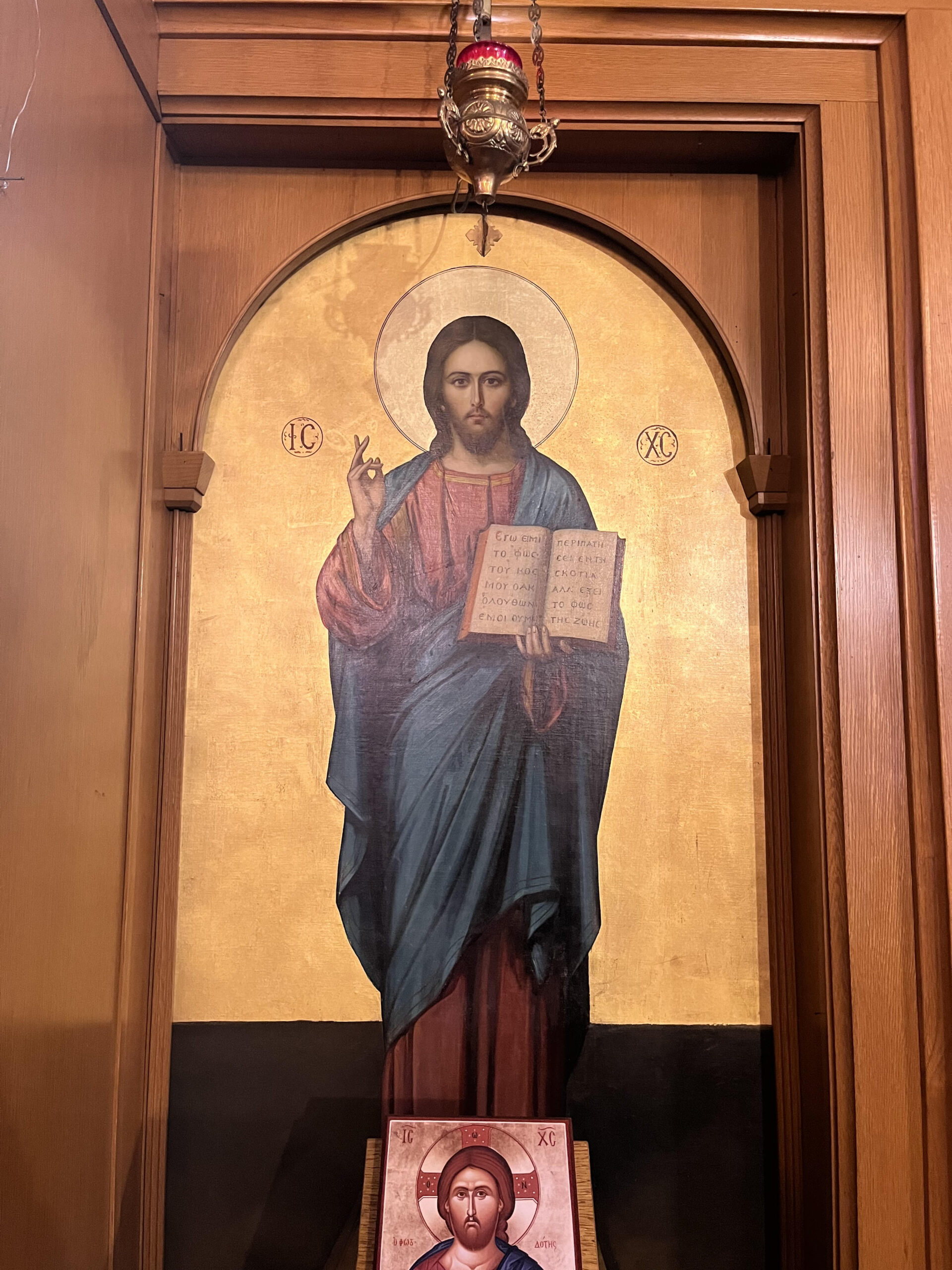
The Gospel of Luke tells the story of the shepherds and the Gospel of Matthew tells the story of the Magi. And these are the scenes that are depicted under our Christmas trees and in the Christmas pageants. However, the most meaningful description of Christmas is found in one verse of the Gospel of John: And the Word became flesh and dwelt among us, full of grace and truth; we have beheld His glory, glory as of the only Son from the Father. (John 1:14)
There are many names ascribed to the persons of the Trinity. The Father is also known as the Almighty, the Creator, God. The Spirit is known as the Holy Spirit, the Comforter, the Counselor, the Paraclete. And the Son is known as Jesus, Christ, the Messiah, the Son of God, the Son of Man, our Savior, and the Word/Logos.
At the Feast of St. Spyridon, which we celebrate a few days ago, we remembered a miracle that was worked through him at the First Ecumenical Council in 325, when a brick he was holding in his hand was separated into its three elements—water, clay and fire. He demonstrated that one could be three, and three could be one, showing how there is ONE God in THREE persons.
In the creation of the world, we read in Genesis 1:1-3, In the beginning, God (the FATHER) created the heavens and the earth, and the earth was without form and void and darkness was over the face of the deep; and the Spirit (HOLY SPIRIT) of God was moving over the waters, and God said (the SON), “Let there be light.” The Holy Trinity was present in the Creation of the world. The Holy Trinity is uncreated.
The Gospel of John begins In the beginning was the Word, and the Word was with God, and the Word was God. He was in the beginning with God; all things were made through Him, and without Him was not anything made that was made. (John 1:1-3) Christ, the Word of God, was in the beginning and was/is God, part of all that was created.
Thus, the Nativity is not merely the birth of Jesus, but the Incarnation of the Word of God in the flesh. In Greek the word is sarkosis, or “taking on flesh.” The Nativity is sometimes called “The Winter Pascha,” because there is a forty-day fast period that precedes it, but also because it is the second great feast after Pascha. At Pascha, the road to Paradise is shown through the death and Resurrection of Christ. However, at the Nativity, the Word of God leaves His throne in heaven and descends to the earth, another act of extreme humility.
Most of us probably don’t think about this, but there is a hymn describing the Incarnation that is part of every Divine Liturgy. It is the second antiphon, sung before the Small Entrance, which is our prayer for today. (In Greek it is O Monogenseos ke Logos tou Theou)
Only Begotten Son and Word (Logos) of God, Who is immortal. For our salvation You humbled Yourself, taking on flesh from the Holy Theotokos and ever-Virgin Mary. Without change You did become man; and were crucified Christ our God, and trampled down death by death. As One, of the Holy Trinity glorified with the Father and the Holy Spirit, save us. (Second Antiphon, Divine Liturgy of St. John Chrysostom)
As we reflected yesterday, there is great meaning in the roles of the shepherds, the Magi, the angels and all of Creation. There is great beauty and meaning in how this is stated in the Gospels and how we display it in our homes. The deepest and most succinct meaning of the Nativity, however, is found in five words of great substance: And the Word became flesh.