But now in Christ Jesus you who once were far off have been brought near in the blood of Christ. For he is our peace, who has made us both one, and has broken down the dividing wall of hostility, by abolishing in his flesh the law of commandments and ordinances, that he might create in himself one new man in place of the two, so making peace, and might reconcile us both to God in one body through the cross, thereby bringing the hostility to an end. And he came and preached peace to you who were far off and peace to those who were near; for through him we both have access in one Spirit to the Father.
Ephesians 2:13-18
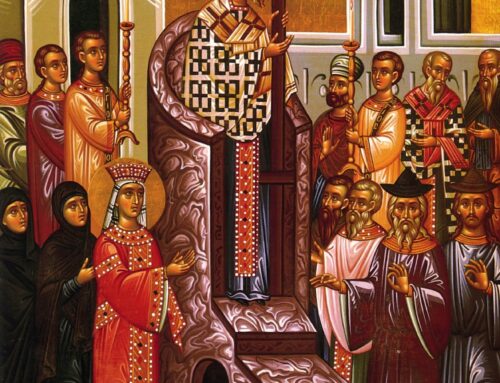
The major feast days of the liturgical year are celebrated for more than one day. For instance, we celebrate Pascha for forty days. The Nativity is celebrated December 25-31. Theophany is celebrated January 6-14. The feast day is the first day of the festal period but the festal period continues for a period of time. We celebrated the Exaltation of the Holy Cross on September 14 and the feast continues through September 21. And festal hymns are heard every day throughout this period.
Many people find repetition boring. However, the more we explore the Bible as well as the hymnology of the Church, we find new layers that reveal deeper meaning. The Orthros service of the Church offers us a biography/explanation in hymns of either the life of a saint, an event in the life of Christ or the Virgin Mary, or a theological explanation. On the feast of St. Demetrios, celebrated on October 26, for instance, we will hear hymns that give us the biography of St. Demetrios. Because reading on a widespread basis came about only in the last few centuries, for the majority of the history of the Church, information was disseminated through worship. This is why the majority of our hymnology is neither praise music nor supplication (asking God for things). The majority of it is didactic, meant to teach us things.
All of this introduction brings us to this extra reflection on the Holy Cross. The other day, while celebrating the Orthros service, two hymns caught my eye because of the powerful theology on the cross expressed in each. We often look at the cross as a story—Jesus was crucified on the Cross. Or we look at it as a symbol—we wear crosses around our necks, and we adorn our churches with crosses. However, even though we are surrounded by images of Christ on the Cross, and while many of us wear one around our necks, we become almost immune to the meaning of the Cross.
O Cross of Christ, the hope of Christians, the guide of the wayward, the haven of the storm-tossed, the victory in wartime, the security of the civilized world, for the sick a physician, for the dead resurrection, have mercy on us. (Idiomelon, Orthros, Feastday of the Holy Cross, Trans. by Fr. Seraphim Dedes)
The Cross does not make life worry-free. Instead our focus on the Cross brings hope, guidance, security, and victory. We know the story of the Cross of Christ. We know that the Cross is a symbol that identifies Christians. But do we look at the Cross as these other things? Do we ever put our hand on the cross we wear around our neck and feel it as a source of power? Do we ever gaze on the Cross of Christ in the church or elsewhere and think of it as a source of hope? The last two phrases of this hymn also provide a powerful contrast. For the sick, the Cross is seen as healer, and as hope. When the Emperor Constantine saw the vision of the cross in the sky, with the words En Touto Nika in Greek (in this sign you will be victorious), he held fast to that hope. I have laid on a hospital bed many times in my life and in those moments, I have often felt fear. There have been many instances in life when I have felt nervous, anxious or afraid. And in the times I actually remember to focus on the cross, seeing in my mind’s eye a visual of a cross, I have found some relief, some hope, and some resolve that I’ll get through whatever I’m going through. It’s the final line of this hymn that is most profound. At some point, we are all going to experience an earthly death. The Cross, for Christ, was the means of His earthly death. But it paved the way for His Resurrection. Likewise, the Cross paves the way for our Resurrection. The Cross is a helper in this life, but cannot extend earthly life forever. The ultimate hope for our lives is eternal life, and the Cross paves the way for this.
Today the Cross of the Lord comes out, and the faithful receive it with longing, and they obtain healings of soul and body and of every infirmity. Let us (venerate) it with joy and with fear: with fear, for we are unworthy because of sin; and with joy, because of the salvation, which Christ the Lord grants us, since He was nailed to the Cross, and He has great mercy. (Doxastikon, Orthros, Feast of the Holy Cross, Trans. by Fr. Seraphim Dedes)
This final hymn of Orthros also paints a dual picture of the Cross. We are to venerate the cross both with joy and fear, the same two postures we should approach Holy Communion, prayer and even God with. There should be a sense of fear in our relationship with God because we are sinful. We should not approach God only with confidence, like the Pharisee, but rather with humility, like the Publican. We are not perfect. However, we should not only approach in fear, because the perfect love of God is supposed to cast out all fear. We should approach with joy and with confidence (tempered by humility) because through the Cross, Christ has offered the opportunity for salvation to the whole world. Therefore, we approach with faith in the Cross, works (which is obedience to the commandments, and repentance when we fail to keep them) and ultimately with hope in the grace of God. Faith, work and grace are the equation for salvation. Fear and joy serve as two motivating tools on that journey. And both are embodied in the Holy Cross of Christ.
O Cross, you are the guardian of the whole world. O Cross, you are the height of the Church’s beauty. O Cross, you are what strengthened the Emperors. O Cross, the believers’ firm support. O Cross, the glory of Angels and the defeat of the demons. (Exapostelarion, Orthros, Feast of the Holy Cross, Trans. by Fr. Seraphim Dedes)
Spend some time meditating on the Cross, and what it means. Use the Cross not just as a story or a symbol on our walls or necks, but as a source of power, hope, support and guidance.