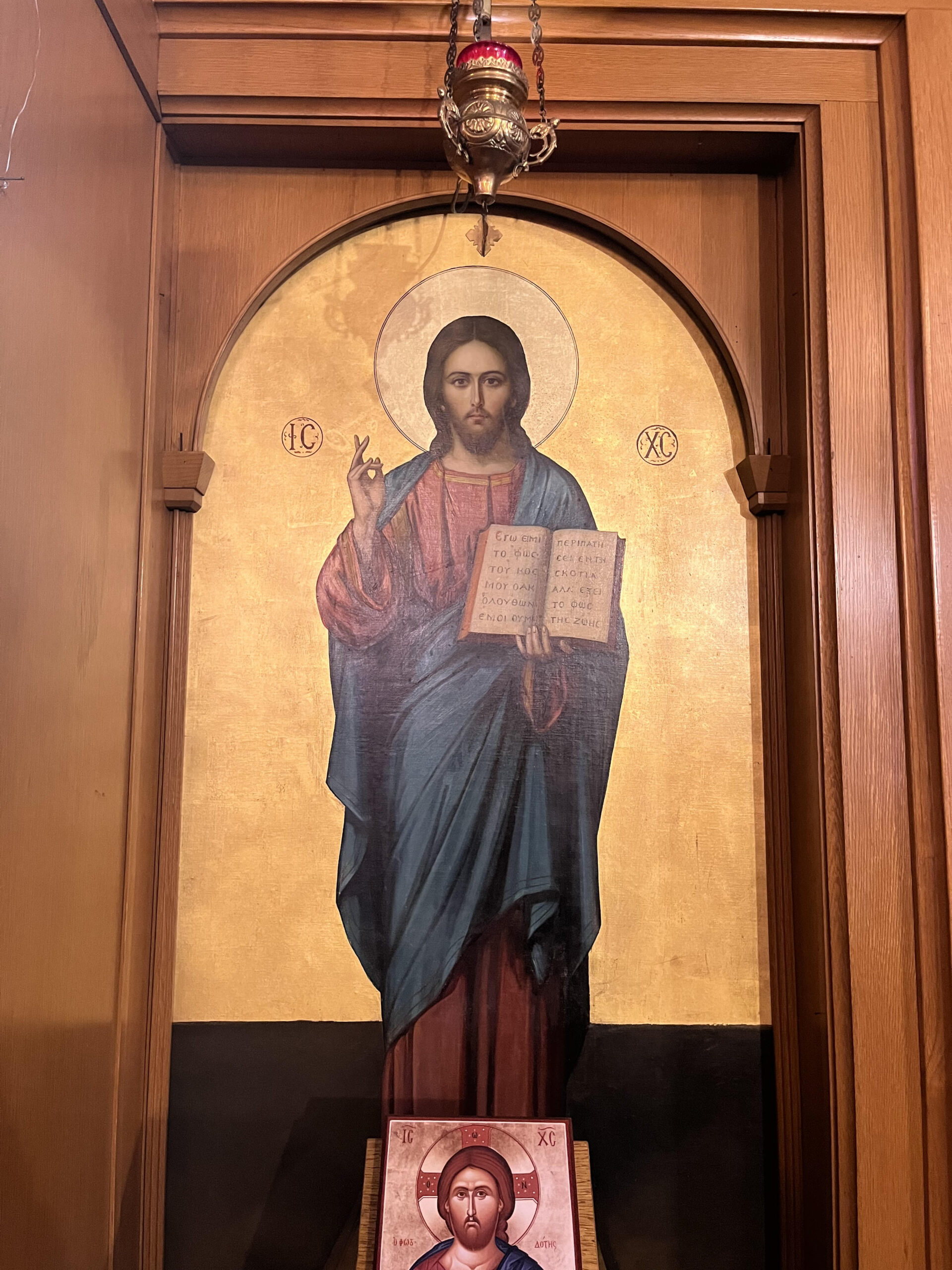
And when you fast, do not look dismal, like the hypocrites, for they disfigure their faces that their fasting may be seen by men. Truly, I say to you, they have received their reward. But when you fast, anoint your head and wash your face, that your fasting may not be seen by men but by your Father who is in secret; and your Father who sees in secret will reward you.
Matthew 6:16-18
The concept of fasting pre-dates Christianity. The Israelites fasted at the base of Mount Sinai before Moses went up to get the Ten Commandments and the Law from God. Other Old Testament figures like Elijah were fasting. Jesus fasted for forty days. Fasting is abstaining from certain kinds of food (or from food all together) in order to promote spiritual discipline. Fasting is not about deprivation or punishment. There are three kinds of fasts in the Orthodox Church:
- The weekly discipline of fasting on Wednesdays and Fridays. We fast on Wednesday in remembrance of the betrayal of Christ by Judas, which occurred on a Wednesday. We fast on Fridays in remembrance of the crucifixion which happened on a Friday. This fast should be kept throughout the year, regardless of whether one is receiving Holy Communion or not. While this fast has often been connected with Holy Communion, the truth is that this is a spiritual discipline that should be followed whether one plans to receive Holy Communion or not. There are four weeks when there is no Wednesday or Friday fast. These are Bright Week (the week after Pascha), from December 25-January 4, the week after Pentecost, and the week after the Publican and the Pharisee (first week of Triodion).
- There are four prescribed fasting periods of the Liturgical year. There is the fast of Great Lent, which includes forty days of Great Lent plus Holy Week. The week prior to Great Lent, we are to abstain from meat. This fast prepares us to celebrate Pascha. The Nativity Fast begins on November 15 and lasts through December 24, a forty-day fast prior to the feast of the Nativity. There is a fast from August 1-14 in honor of the Dormition of the Virgin Mary, which is celebrated August 15. The fourth fast period is often overlooked, and it is called the Apostles Fast. This lasts from the Monday after All Saints Day (8 Sundays after Pascha) through June 28. The feast of Sts. Peter and Paul is June 29. Depending on the date of Pascha, this fast period lasts between 0-32 days. Through these fasting periods, the church calls us to a longer period of spiritual discipline related to food.
When fasting, we typically fast from meat, fish, dairy products, wine and oil, though there is some relaxation on some of these things—there are days when fish is allowed, or oil and wine are allowed. Most Orthodox Churches provide a calendar which indicates the fast days and their degree of strictness.
- The third fast is the fast for Holy Communion. This fast involves abstaining from ALL food from midnight, the night before one is to receive. This means that when one wakes up, the morning he or she is going to receive, that no food or water is taken. If one take medication, water is allowed for purposes of taking the medication. The reason for this complete abstaining from food is so that the first thing we are putting into us is Christ, this is a discipline to put Christ first, as concerns our food intake for the day. If there is a Divine Liturgy on a Monday, as an example, there is no additional fasting required the day before, only an abstinence from food on Monday morning. It is the same with receiving Holy Communion on Sunday morning. Unless the Church is in a fasting period, there is no fast required on Saturday. This presumes one is fasting on Wednesdays and Fridays. For an evening Divine Liturgy, one should have lunch at midday and then curtail consumption of food for several hours before the evening Divine Liturgy.
The fasting requirements are modified if one must take medication with food. If this is the case, a simple meal with medication is fine before receiving Holy Communion. Fasting is also curtailed if one is sick, pregnant or nursing. This is why one should consult with both their priest (spiritual father) and doctor regarding fasting.
Fasting again is more about discipline than deprivation. If one can be disciplined in what he or she eats, then that discipline can carry over to what one says or does or even thinks. We all have passions, things that we are attracted to. Some of those passions are good—one might have a passion for cooking, dancing, or doing charity work. But some of the passions are bad, all have a passion for anger, lust, power, ego, money, etc. One of the most basic passions is food. We can go for a while without an angry thought or a lustful thought, but we can’t go for more than a few hours without a hungry thought. This is why the goal is to tame a passion for hunger with the goal of being able to tame other passions as well.
In contemporary times, the greatest passion we have, it seems, is for our phones. We spend hours endlessly scrolling. I would never suggest not fasting from food, but it would be beneficial on fasting days to do some kind of fast from our phones. One intent of fasting is that it involves a time element. In years passed when people had to hunt for their food, fasting meant eating fruits and vegetables that grew close to home, thereby freeing up time to pray and worship. We order a lobster instead of a steak at a restaurant and that is fasting from food, but there is no time element in it. When fasting, we should put a greater emphasis on spiritual disciplines like prayer, Scripture reading and worship. Otherwise fasting becomes just dieting.
Jesus says in Matthew 6:16, “And WHEN you fast,” not If you fast. Fasting is something that we are to do, it is part of an authentic Orthodox spiritual life. Jesus also tells us that we shouldn’t make a big production out of fasting or call attention to our fasting. If we are fasting and we are a guest in a home where they are serving meat, we aren’t supposed to call attention to the fact that we are fasting. Just politely eat what is served and resume the fast with the next meal. We also aren’t to disfigure our faces, change our behavior. Rather we are to “anoint your head”. This is why at the beginning of the Nativity Fast and the beginning of Great Lent, we celebrate the Sacrament of Holy Unction in the parish I serve, to receive anointing that no one will be able to see and keeping in line with Jesus’ teaching to fast and how to fast.
If you have never kept a fast before, start slow. Begin by fasting from meat on Fridays, then add Wednesdays after a few months. Don’t try to do a strict fast for forty days if you’ve never fasted. Each fast period, go a little more strict until you reach the level of the traditional fast. Fasting is often dismissed as irrelevant or outdated. Neither is true. Fasting is an important part of Orthodox spirituality and has been since the beginning of Christianity. It is about discipline and not about deprivation. It helps us build discipline and helps in our growth towards Christ.
The Lord is my shepherd, I shall not want; He makes me lie down in green pastures. He leads me beside still water; He restores my soul. He leads me in the paths of righteousness for His name’s sake. Even though I walk through the valley of the shadow of death, I fear no evil; for Thou art with me; Thy rod and Thy staff, they comfort me. Thou prepares a table before me in the presence of my enemies; Thou anointest my head with oil, my cup overflows. Surely goodness and mercy shall follow me all the days of my life; and I shall dwell in the house of the Lord forever. Psalm 23
Points to ponder: Do you fast regularly? Do you combine prayer with fasting? How can you be more attentive to the spiritual discipline of fasting?